Impersonation of Alfred Inglethorp to frame him for the poisoning
The Mysterious Affair at StylesThe Impersonation of Alfred Inglethorp to frame him for the poisoning is the deliberate false purchase of strychnine that makes Alfred appear to have obtained the poison used in Emily Inglethorp’s death. At the inquest, Albert Mace identified Alfred as the customer who bought it; Hercule Poirot later showed that the identification rested on a likeness assembled from beard, glasses, and conspicuous clothes, while Alfred’s alibi placed him miles away. The apparent proof against Alfred was therefore not simply mistaken: it was the central device of a frame-up.
The purchase as evidence
At the inquest, the Coroner called Mace, a qualified pharmacist who had only recently joined the village chemist’s shop. Asked whether he had sold strychnine to an unauthorized person, Mace said that he had. Asked to whom, he answered that the buyer was Alfred Inglethorp. The room’s attention shifted to Alfred, who remained seated and appeared impassive as the accusation landed.
Mace’s account included a detail that made the transaction seem credible. Alfred had signed the poison book, as purchasers customarily did, and told Mace that the strychnine was intended to poison a dog. Mace explained that, recognizing him as a man of the Hall, he had seen no reason to refuse the sale. The household’s standing in the village had thus helped make the supposed purchase plausible, while the signed record appeared to give the accusation documentary support.
That evidence was especially damaging in the context of Emily’s death. The post-mortem established that she had died from strychnine poisoning, and the amount recovered indicated that she had taken at least three-quarters of a grain, probably a grain or slightly more. The inquest also considered whether the poison could have been put in her after-dinner coffee, but the symptoms appeared in the early hours, much later than the usual one-to-two-hour interval after swallowing strychnine. The purchase accusation therefore offered an apparently simple connection between a named suspect and the lethal substance, even though the timing raised questions about how the poison had been administered.
How Poirot breaks the identification
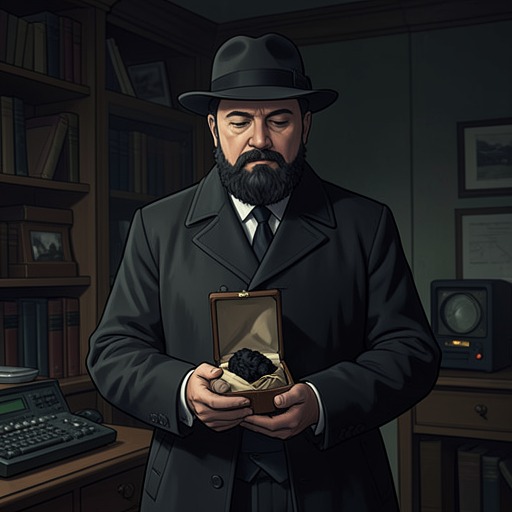
Poirot’s objection was not that Mace had fabricated his account, but that he had mistaken resemblance for recognition. As Poirot reconstructed it, Mace had seen a man with a black beard like Alfred’s, glasses like Alfred’s, and Alfred’s notably recognizable clothes. Mace could report the appearance he saw; he could not establish that the person beneath the disguise was Alfred. He had probably seen Alfred only at a distance, had been working in the village for just a fortnight, and Emily’s household generally dealt with Coot’s Cash Chemists in Tadminster rather than the local shop.
The disguise made the supposed purchase look less like a credible act by a calculating murderer than an arrangement designed to point suspicion at Alfred. Poirot reasoned that a murderer who understood the danger of detection would hardly buy poison under his own name, invent an easily challenged explanation about a dog, then use it only after a notorious quarrel had already directed the household’s attention toward him. Nor would such a person knowingly leave the chemist’s assistant available to identify him while preparing no apparent defense. The purchase’s excess of incriminating detail was itself a reason to doubt it.
Poirot sharpened the distinction with a direct conclusion: “Very simply. He did not buy it.” The assertion did not erase Mace’s testimony or the signed entry; it changed what those details could prove. They established that a customer had acquired strychnine while presenting himself as Alfred, not that Alfred had made the purchase.
The alibi and the reversal
The decisive counter to the identification was Alfred’s whereabouts. Poirot stated that at six o’clock on the Monday when the strychnine was bought, Alfred was escorting Mrs. Raikes back to her home from Abbey Farm. He said that at least five witnesses could place the pair together at six or shortly afterward. Abbey Farm was at least two and a half miles from the village, making it incompatible with Alfred’s being the customer in the shop at that time.
Poirot’s announcement transformed the inquest’s most sensational testimony. Mace’s confident identification had seemed to connect Alfred to the poison; the alibi exposed the gap between a recognizable costume and the person wearing it. Alfred sprang up and began to challenge Poirot, but broke off before completing his protest. In the exchange, the supposed buyer’s identity ceased to be settled by the witness’s certainty and became the question the investigation had to answer.
The frame-up also helps explain why the evidence against Alfred looked so neatly arranged. A purchase under his name, a written signature, a convenient explanation, and a household quarrel all converged on one suspect. Poirot regarded that convergence not as proof of guilt but as a contrivance too conspicuous to be credible. The plot depends on a reversal in the meaning of evidence: the closer the transaction appears to implicate Alfred, the more urgently its particulars demand scrutiny.
Poison, timing, and the larger design
The false purchase was one of several appearances of strychnine that made the case confusing. Poirot counted the poison in Emily’s tonic, the strychnine sold by Mace, and another quantity handled by someone in the household. The repetition risked making the purchase seem like a straightforward trail to the murderer, but Poirot treated the abundance itself as a reason to distinguish the different sources and uses of the substance.
The eventual explanation turns on the tonic rather than on the shop purchase. Poirot disclosed that the remaining cocoa had been tested not only for strychnine, as in Dr. Bauerstein’s analysis, but also for a narcotic. The distinction mattered: the earlier test answered whether strychnine was present, not whether the cocoa contained a different drug. The investigation’s attention to what a sample had—and had not—been tested for demonstrates how apparently conclusive findings could leave essential questions unresolved.
Poirot also explained that an empty box of bromide powders connected to a prescription bottle containing strychnine could account for the delayed, fatal dose. A medical text described how a similar mixture deposited much of its strychnine as insoluble crystals; if the bottle was not shaken, the sediment could remain at the bottom and concentrate in the last dose. The planned death was apparently meant to occur on Monday evening, when Emily would have been alone in the right wing and her bell wire had been cut. But she forgot to take her medicine before going to a village entertainment, then lunched away from home the next day. The fatal dose was consequently taken twenty-four hours later than intended, leaving Poirot with the final proof.
Against that more intricate poisoning mechanism, the ostentatious shop purchase reads as misdirection rather than as the source of the fatal dose. Its narrative importance lies in how it exploits ordinary standards of proof—a witness, a signature, a named buyer—while inviting Poirot to ask whether the evidence identifies a person or merely an appearance. The false transaction first threatens to close the case around Alfred; once tested against time, distance, and the limits of Mace’s recognition, it becomes evidence that someone has deliberately tried to close it too soon.